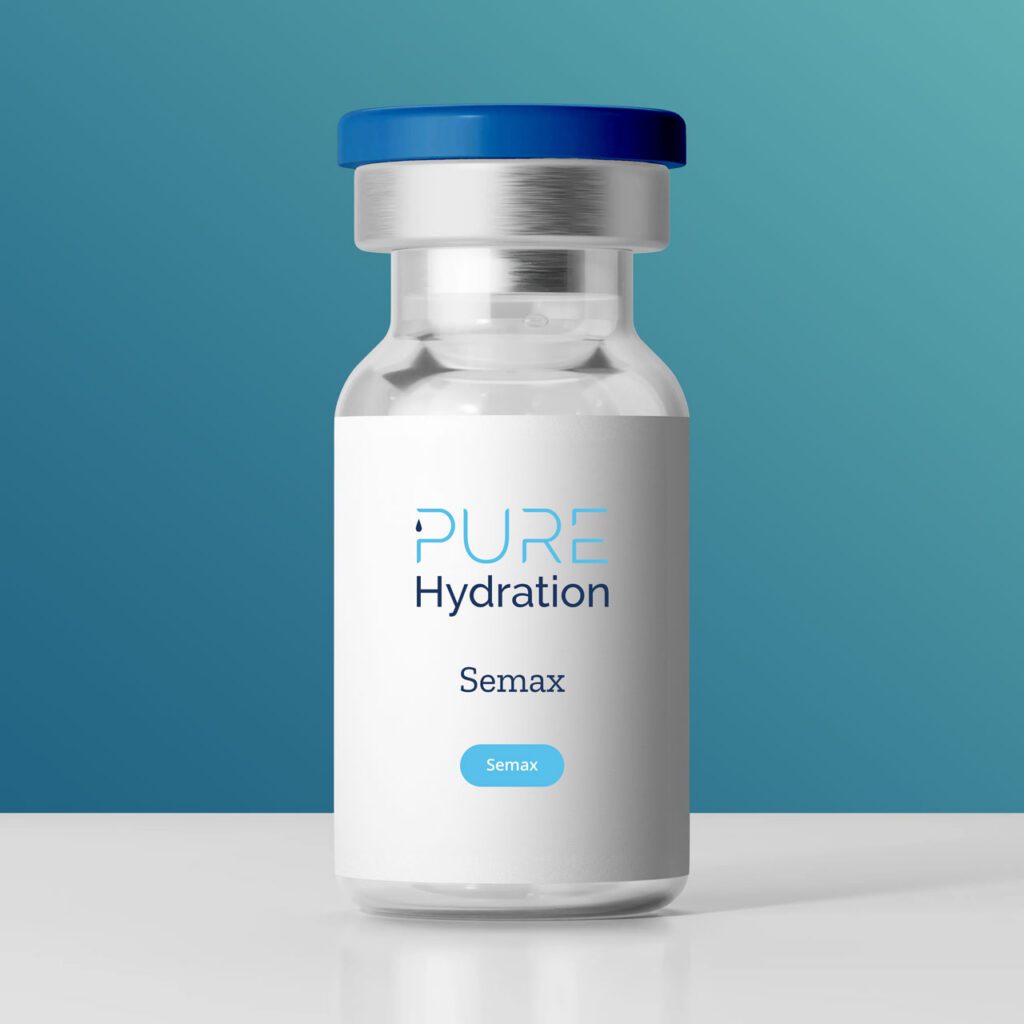
Semax is one of the most studied neuropeptides in cognitive performance research — developed originally as a neurological treatment and now used widely in physician-supervised wellness protocols for focus, memory, and stress resilience. Its mechanism centers on BDNF, a protein the brain uses to build and maintain the neural connections that underlie memory, learning, and cognitive endurance. If Selank addresses the emotional and stress-regulatory side of performance, Semax addresses the structural and functional side — how well the brain actually processes, retains, and retrieves information when it’s under load. Pure Hydration offers physician-supervised Semax protocols shipped directly to patients anywhere in the U.S. It’s also available as part of the NeuroBoost blend for patients who want the combined cognitive and stress-resilience effect of Semax and Selank together.
Benefits
Semax tends to attract two types of patients. The first group is dealing with something that feels like cognitive decline — memory that isn’t as reliable, focus that fractures more easily, mental fatigue that shows up earlier in the day than it used to. The second group is performing well but wants to perform better — high-output professionals, athletes, and people who take their brain health as seriously as their physical health. Both are drawn to Semax because it works through BDNF — brain-derived neurotrophic factor — a protein that supports neuroplasticity, the brain’s capacity to form and strengthen the connections that underlie memory and learning. Elevated BDNF activity is associated with sharper recall, faster processing, and better cognitive resilience under stress. Beyond BDNF, Semax also influences dopaminergic and serotonergic activity, which contributes to its reported effects on motivation and mood stability. Semax is frequently paired with Selank for patients who want to address both sides of cognitive performance simultaneously — the structural and the stress-regulatory. These are mechanism-based observations — individual response varies, and your provider will help determine whether Semax is the right fit for your specific goals and health history.
Safety Information
Semax has a solid safety profile across the research literature and is generally well-tolerated in clinical use. The most commonly reported side effects are mild — occasional dizziness, dry mouth, or mild headache, particularly in the early days of a new cycle. It is not recommended for patients with uncontrolled hypertension. Patients on medications affecting blood pressure, mood, or neurological function should disclose their full medication list before starting. Mild injection site reactions can occur and typically resolve quickly. Semax does not carry addictive potential and does not function as a stimulant — a meaningful distinction from pharmaceutical cognitive enhancers. All protocols are physician-supervised from intake through completion, and your clinical team reviews everything before your first cycle ships.
Regimen
Semax is run as a 6- or 12-week protocol on a daily schedule . Morning injections are standard. Cognitive peptides generally perform best when dosed at the start of the day, before the demands of a normal afternoon begin to accumulate. The 6-week protocol is a solid starting point for patients new to Semax — enough time to evaluate how the brain responds before committing to the longer cycle. The 12-week option is typically recommended for patients with more significant cognitive goals or those who responded well in their first cycle and want to extend the neurological environment it creates. Because Pure Hydration’s peptide program is fully remote, your protocol ships directly to you on a schedule aligned with your cycle — wherever you are in the country.
How to Take
Semax is administered as a subcutaneous injection near the lower abdomen or outer thigh. The injection takes under a minute once the technique is comfortable. Use clean, sterile protocol every time: wash hands thoroughly, prep the skin with an alcohol swab and let it dry completely before injecting, and rotate injection sites to avoid irritation or buildup at any single location. Never inject into skin that’s bruised, inflamed, or scarred. Each shipment from Pure Hydration includes your peptide vials, bacteriostatic water, two weeks of sealed needles, a protocol-specific dosing guide, and a full injection guide. A video tutorial is also available for patients new to self-injection, walking through proper technique step by step.
How It Works
Semax is a synthetic heptapeptide derived from the first four amino acids of ACTH — adrenocorticotropic hormone — a pituitary peptide involved in the stress response and neurological regulation. Its primary mechanism is the upregulation of BDNF, brain-derived neurotrophic factor, a signaling protein that supports the growth, maintenance, and plasticity of neurons. Higher BDNF levels are associated with stronger synaptic connections, more efficient memory consolidation, and greater cognitive resilience under stress — which is why BDNF has become one of the most studied targets in both cognitive performance research and neuroprotective medicine. Semax also influences dopamine and serotonin metabolism, which contributes to the motivational and mood-stabilizing effects that patients commonly report alongside the cognitive ones. It works through endogenous neurological pathways rather than by flooding the system with stimulating compounds — a meaningful distinction for patients who’ve had negative experiences with pharmaceutical cognitive enhancers or stimulants.
FAQs
1. What is Semax?
Semax is a synthetic peptide that has been studied for its potential effects on neurological function and certain brain-related pathways. It has been researched internationally for several uses, but it is not currently an FDA-approved medication in the United States.
2. What is Semax used for?
Semax has been studied for neurological applications, including conditions involving cerebral ischemia, migraine, and trigeminal neuralgia. Some people also seek Semax for cognitive or wellness-related goals, although these uses have not been approved by the FDA.
3. Does Semax help with focus and mental clarity?
Semax is often discussed in connection with focus, cognition, and mental performance, but research in humans is limited and these benefits have not been established or approved by the FDA. Your provider can discuss whether Semax is appropriate for your individual goals.
4. How is Semax taken?
Semax may be prepared in different forms depending on the prescribing provider and pharmacy. Patients should follow the exact directions provided with their treatment and should not adjust the dose or frequency without speaking with their provider.
5. How quickly does Semax work?
Response can vary from person to person, and there is not a well-established timeline for when someone should expect to notice an effect. Your experience may depend on the formulation, dose, treatment plan, and individual response.
6. Is Semax FDA approved?
No. Semax is not currently FDA approved in the United States. The FDA has also identified potential concerns with compounded Semax, including peptide-related impurities and possible immunogenicity, and continues to evaluate Semax-related bulk drug substances.
7. What are the possible side effects of Semax?
Safety data for Semax in humans are limited. Possible risks may depend on the formulation and route of administration. Because compounded medications do not undergo the same FDA premarket review as approved drugs, treatment should be discussed with a qualified medical provider.
How to Use Your Peptides
Book a Consultation
More Like Semax

Not all patients qualify for all treatments – book a free consultation to find out what program is right for you.